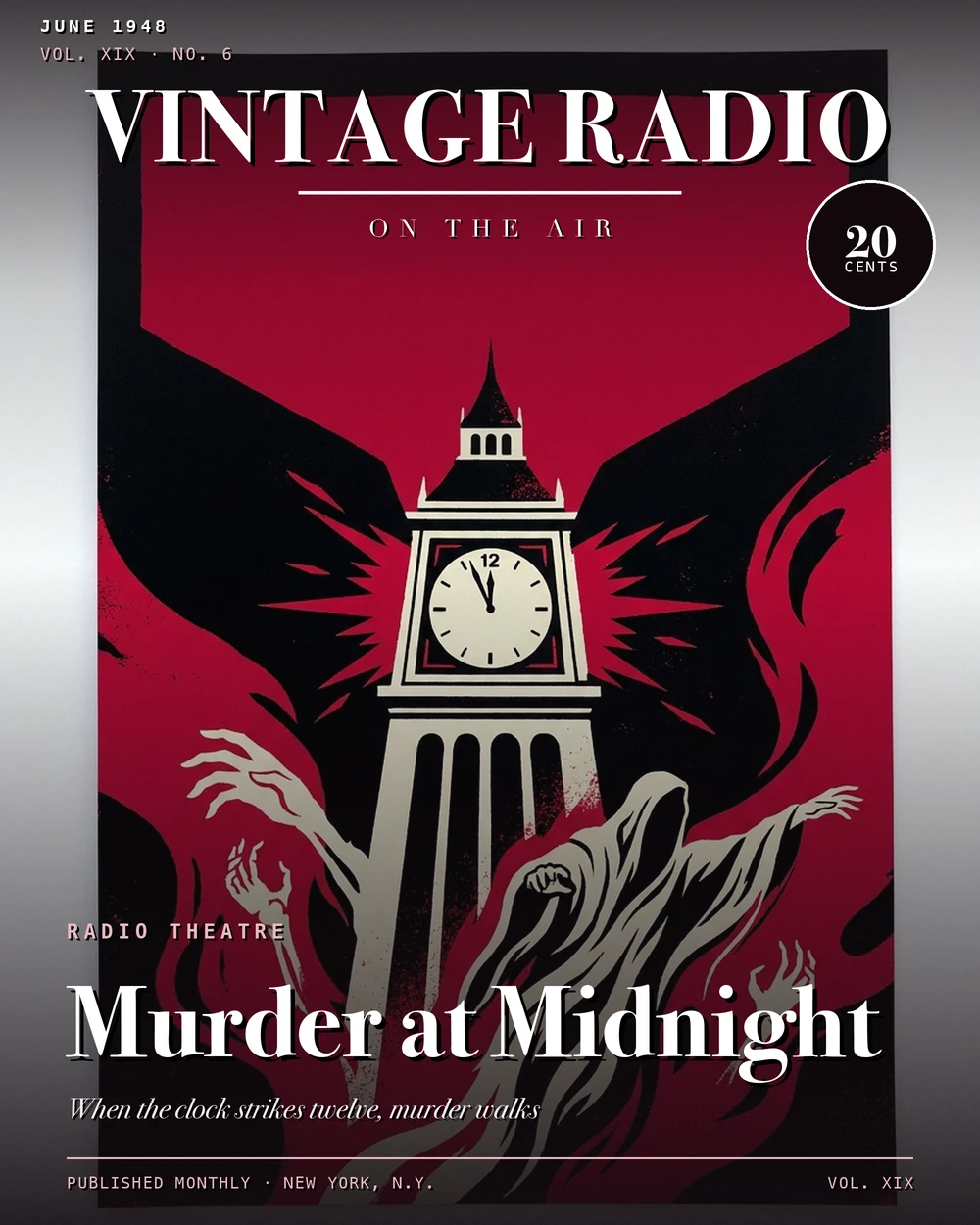
Murder at Midnight
That Voice, That Opening
Murder at Midnight opened each episode with narrator Raymond Morgan stretching the title across the airwaves — "MURRR-DERRR—A-A-AT MIID-NIIGHT" — followed by a description of the witching hour: "when night is darkest, our fears the strongest, our strength at its lowest ebb... Midnight!... when graves gape open and death strikes." That was the promise every week, delivered in a voice that somehow felt like it came from somewhere just past the edge of the room.
Morgan was an unusual figure for the job. He had been a Long Island minister before leaving the pulpit for a career in radio, and that background came through — not in any preachy way, but in the deliberate, weighted delivery of someone who understood how language could work on an audience. He didn't rush. The opening signature became the show's calling card, and Charles Paul's creepy organ score did the rest, building out the atmosphere with the kind of musicality the horror genre leaned on hard in the 1940s.
How It Got Made
Murder at Midnight was a transcribed syndication series — recorded in advance and distributed to stations, rather than broadcast live from a single network. Producer Louis G. Cowan ran it through his independent production company, with the World Broadcasting System handling distribution. All 52 episodes were recorded from mid-April through December 1946, with the final two copyrighted in 1947. The show first aired on KFI Los Angeles in the spring of 1946, possibly as early as April 19, before beginning its run on WJZ New York that September. By 1949, the series had been sold to 173 stations across the United States, in markets ranging from eight thousand to eight million listeners, and it eventually reached Alaska and Hawaii as well. The show continued turning up in syndication into the early 1960s.
Cowan — born Louis Cohen in Chicago on December 12, 1909, he changed his name at 21 — was already a significant figure in American radio by the time he put Murder at Midnight together. He had graduated from the University of Chicago with a doctorate in history and served as director of Voice of America from 1943 to 1945, appointed by President Franklin D. Roosevelt. After this show, he created Stop the Music! in 1948 and The $64,000 Question for television in 1955, eventually serving as president of CBS television starting in March 1958 before resigning in December 1959 in the wake of the quiz-show rigging scandal. He died in a fire in New York City on November 18, 1976.
To attract writers to the project, Cowan offered a flat fee per script plus a percentage of the profits — a revolutionary arrangement for 1946. Lead writer Robert Newman had come off Inner Sanctum Mysteries, and Max Ehrlich had been writing for Suspense. About a dozen writers contributed scripts during the run, including Joseph Ruscoll and William Morwood alongside Newman and Ehrlich.
The Show It Was Modeled On
Murder at Midnight was consciously built on the template of Inner Sanctum Mysteries, mixing horror, mystery, the supernatural, and the macabre into 30-minute weekly stories. Some episodes were adapted from or borrowed scripts that had already appeared on Inner Sanctum — and the connection ran deeper than just format. Raymond Edward Johnson, the original host of Inner Sanctum, turned up as a performer in at least two Murder at Midnight episodes. Several writers on the show also had credits on Bulldog Drummond. It was, in that sense, a series built by people who already knew the territory.
Variety was not particularly impressed, calling it "just another routine chiller series" and comparing the writing to horror films from ten years earlier. That may have been fair as a critical judgment, but it didn't slow the show's syndication spread. The Library of Congress copyright catalogues for 1946 and 1947 — which list every episode with production numbers, copyright dates, and writers' names — provide the clearest record of what was produced and when. Director Anton M. Leader (credited in some sources as Anton M. Leder) kept the productions tight and consistent, and went on afterward to direct and produce Suspense from 1948 to 1949, including its expansion into one-hour dramas with Robert Montgomery as host.
The Cast
The performers were drawn from New York's working radio pool, and the roster on any given week was strong. Mercedes McCambridge appeared on the show at a point when she was one of the most in-demand radio actresses in the city. Orson Welles had called her "the world's greatest living radio actress," and she had earned that reputation through work on Inner Sanctum, I Love a Mystery, and Bulldog Drummond after moving to New York in 1942. She had been signed to a five-year NBC Radio contract before she even graduated from Mundelein College in 1937. By the time Murder at Midnight aired, McCambridge was about to make a film debut that would change her career entirely: she won the Academy Award for Best Supporting Actress for All the King's Men in 1949 and earned a second nomination for Giant in 1956. She would later provide the voice of the demon Pazuzu in The Exorcist in 1973 — a role for which she was initially uncredited and eventually sued Warner Bros.
Alongside McCambridge, the show featured Berry Kroeger, Elspeth Eric, Carl Frank, Barry Hopkins, Lawson Zerbe, Charlotte Holland, Betty Caine, Ann Shepherd, and Karl Swenson, among others. Kroeger appeared as Dr. Gough in "The House Where Death Lived," and Swenson had a role in "The Ace of Death," Max Ehrlich's adaptation of Robert Louis Stevenson's "Story of the Young Man with the Cream Tarts" from The Suicide Club. Elspeth Eric starred in "Till Death Do Us Part" as Prof. Ruth Clark, opposite Eric Dressler as Prof. Frank Clark; the New York Times listed that episode for WJZ on December 9, 1946, and "Murder Is a Lonely Business" — written by William Morwood and starring Helen Shields and Wendell Holmes — the following week on December 16.
What the Stories Were About
The episodes ranged across familiar horror territory while occasionally pushing into unexpected corners. "Terror Out of Space" — episode 23 — features a scientist who accidentally makes contact with a hostile intelligence while trying to bounce an electronic signal off the moon, giving the show a science-fiction dimension unusual for this kind of program. "The 13th Floor" involves a horror that may be a guilt-driven hallucination or something genuinely terrible, and the show doesn't settle the question cleanly. "Nightmare" follows a wife whose prophetic dream foresees her own murder. "The Creeper" tells the story of a serial killer targeting redheaded women. "Trigger Man" centers on a man carrying a weapon who has six months to live and has consequently lost any fear of consequence.
Not every episode played it straight. "The Secret of XR-3" features a sympathetic murderer driven to desperate action by sustained harassment — a story that registers differently from the usual monster-of-the-week format. "The Kabbala," written by Robert Newman and starring James Van Dyke as Dr. Rudd, pulled from a different kind of darkness entirely. The scripts weren't all equally strong — a dozen different writers across 52 episodes means uneven quality — but the range kept the series from settling into pure formula.
The Later Life of the Series
When WOR New York re-aired the series in 1950 as part of a Mutual network run, it abandoned the original episode sequencing entirely. That rerun was cut short on July 31, 1950, when time slots were preempted by Korean War news coverage. "Terror Out of Space" was scheduled to air that night but got bumped for the Korean News Round-Up — an abrupt and fitting end for a show that had always been at the mercy of the schedule.
The precise episode count has been debated among researchers for years. Wikipedia initially listed 51 produced episodes, with two never aired; a 2011 revision based on the 1946 Library of Congress copyright catalogue brought that number down to 50. Research by historian Karl Schadow settled on 52 total episodes, including the two copyrighted in 1947. A maintained set of the series was released in July 2019 containing all 52. Whatever the final count, Murder at Midnight ran long enough and reached widely enough to establish itself as a genuine piece of horror's radio history — built from the same mold as Inner Sanctum, staffed by writers and performers who knew exactly what the audience wanted, and sent out across the country to do its work in the dark.